
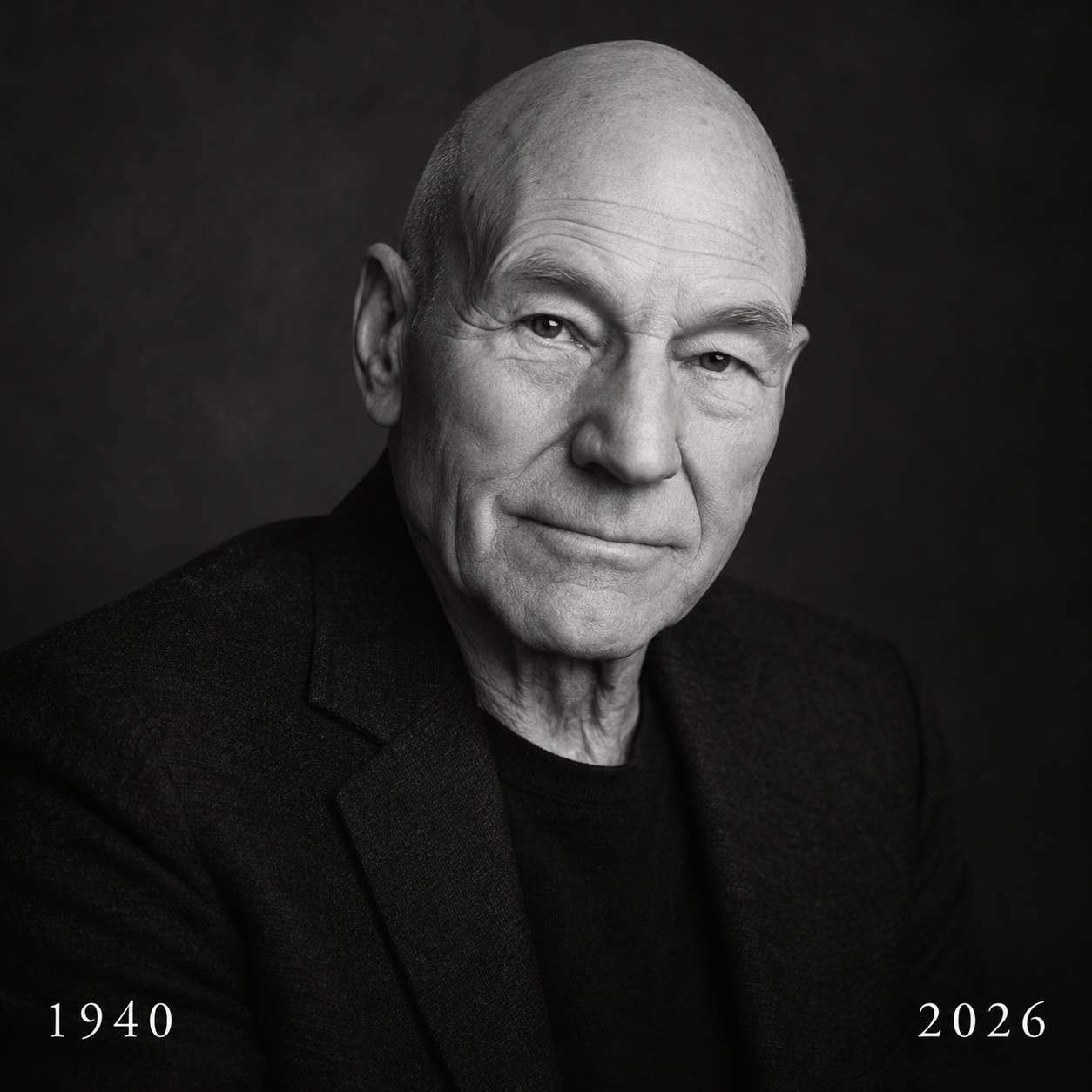
The legendary British actor, best known as Captain Jean-Luc Picard in Star Trek: The Next Generation and Professor Charles Xavier in the X-Men franchise, has died at the age of 86 following a brief journey with Alzheimer's disease and Lewy body dementia.
The world of cinema and television has lost one of its most distinguished performers. Sir Patrick Stewart, the acclaimed British actor who became a household name as Captain Jean-Luc Picard in Star Trek: The Next Generation and Professor Charles Xavier in the X-Men franchise, has died at the age of 86. He passed away at his home in Los Angeles on Wednesday, October 28, following what his spokesperson described as a brief and poignant journey with Alzheimer's disease and Lewy body dementia. He is survived by his wife, singer-songwriter Sunny Ozell, and his two children, Daniel and Sophie.
Stewart's journey to international stardom was anything but conventional. Born on July 13, 1940, in Mirfield, West Yorkshire, England, he grew up in a working-class family. His father, Alfred Stewart, was a military veteran who later worked as a laborer, while his mother, Gladys, worked in a textile factory. His childhood was difficult, marked by financial hardship and domestic violence. He would later speak openly about witnessing his father physically abuse his mother, an experience that profoundly shaped his life.
Acting became his refuge. He discovered his love for Shakespeare at the age of 12, when an English teacher gave him the role of Shylock in The Merchant of Venice. It was a turning point. After leaving school at 15, he briefly worked as a newspaper reporter and furniture salesman before receiving financial support from a local arts council to study at the Bristol Old Vic Theatre School. He began his professional acting career in 1959 and joined the prestigious Royal Shakespeare Company in 1966.
For years, Stewart established himself as one of Britain's finest stage actors, taking on some of the most demanding roles in classical theatre. His performances in Hamlet, Macbeth, Othello, The Tempest and Antony and Cleopatra demonstrated the depth of his craft. His Shakespearean training gave him an extraordinary command over language, voice and physical expression. He earned two Laurence Olivier Awards and remained deeply connected to theatre even after Hollywood came calling.
His biggest breakthrough, however, arrived when he was already 47. In 1987, Stewart was cast as Captain Jean-Luc Picard in Star Trek: The Next Generation. At the time, few could have predicted that this classically trained British theatre actor would become one of science fiction's most recognisable faces. Picard was not the conventional action hero. He was thoughtful, diplomatic, intellectual and guided by a strong moral compass. Stewart brought immense dignity and authority to the character, making him an enduring television icon.
He reprised the role in four feature films — Star Trek Generations (1994), Star Trek: First Contact (1996), Star Trek: Insurrection (1998) and Star Trek: Nemesis (2002) — before returning to the character in the series Star Trek: Picard, which ran from 2020 to 2023.
Stewart was once asked about the possibility of being remembered forever as Picard. In a 1997 interview with The Washington Post, he said, "For a lot of people, I will be locked for all time on the bridge of the Enterprise in my spacesuit." He added, "Not only am I reconciled to that, I'm quite proud of it." It was a telling response from an actor who understood the extraordinary connection audiences had developed with his character.
If Star Trek introduced him to millions, the X-Men franchise gave him another defining cinematic identity. In 2000, he appeared as Professor Charles Xavier, the founder of the X-Men and mentor to a group of mutants struggling to find acceptance in a world that feared them. His portrayal brought compassion, wisdom and moral complexity to the character. Opposite Ian McKellen's Magneto, Stewart created one of the most memorable relationships in superhero cinema. He went on to play Xavier in several films across the franchise, including X2, X-Men: The Last Stand, X-Men: Days of Future Past and Logan. His appearance in Logan was particularly memorable, offering a moving and vulnerable interpretation of a character audiences had known for years.
His filmography extended well beyond these two celebrated franchises. He appeared in films such as Conspiracy Theory, Jeffrey and the critically acclaimed thriller Green Room. His distinctive voice also made him a sought-after performer in animation and comedy, with credits including Gnomeo & Juliet and Ted. Whether playing a superhero mentor, a science-fiction captain or a character in a dark independent film, Stewart brought an unmistakable presence to the screen.
Despite his enormous success, he never abandoned his theatrical roots. He continued to perform Shakespeare and appeared on Broadway, including in A Christmas Carol. His work earned him a Tony nomination, four Emmy nominations and a Grammy Award for the spoken-word recording of Prokofiev: Peter and the Wolf. He was knighted by Queen Elizabeth II in 2010 for his services to drama.
Perhaps one of the most revealing aspects of Stewart's personality was his willingness to speak about his vulnerabilities and the experiences that shaped him. In a 2014 interview, reflecting on his training as an actor, he spoke about how he had learned to draw upon his personal experiences. "We were taught how to store emotions," he said. "It means no experience is ever wasted." It was an insight into the philosophy behind his performances: every emotion, every memory and every difficult experience could become part of an actor's creative vocabulary.
He was equally candid about his childhood. In 2009, he wrote about the domestic violence he witnessed growing up, describing his home life as "barely tolerable". Years later, he became a vocal advocate against domestic abuse, working with Amnesty International and supporting the British charity Refuge. He believed that silence allowed abuse to continue and used his public profile to encourage conversations around violence against women and its impact on children.
In 2023, Stewart published his memoir, Making It So, offering readers a more intimate account of his childhood, his struggles, his theatre years and his remarkable rise to international fame. He also reflected on his success with a characteristic lack of self-importance. In a 2023 interview with The Guardian, he admitted, "I think I've been in denial about my life for a very long time. I never really took on board how successful I had become." He added that even later in life he would sometimes think, "You're a lucky son of a bitch, Patrick," when something unexpected or good happened to him.
That humility, combined with his formidable talent, made him an admired figure among colleagues and audiences alike. His friendships with fellow actors Ian McKellen and Hugh Jackman were well known. Jackman, his X-Men co-star, paid tribute to him, describing him as one of the greats of stage and screen, as well as a tremendous friend from whom he had learned a great deal.
For millions, he will forever be Captain Jean-Luc Picard, delivering the words "Make it so" with quiet authority. For another generation, he will remain Professor Charles Xavier, the compassionate mind behind the X-Men. But beyond the characters, Patrick Stewart will be remembered as an actor who brought intelligence, dignity, warmth and immense humanity to everything he did. The final curtain has fallen on a remarkable life, but the performances remain. Make it so, Sir Patrick. Your legacy is eternal.